 how-to
How to Finance Metal Buildings: A 2026 Guide
Table of Contents
- Types of Financing Vehicles for Metal Buildings
- How to Finance Metal Buildings: A Step-by-Step Application Checklist
- Metal Building Down Payment Requirements and Interest Rates
- Barndominium Construction Loans: What You Need to Know
- Affordable Metal Building Kits 2026: Financing Through Manufacturers
- Tax Implications and Insurance for Financed Metal Structures
- Regional vs. National Lenders: Which Is Right for You?
- Conclusion
- Frequently Asked Questions
Last Updated: September 28, 2026
Types of Financing Vehicles for Metal Buildings
Learning how to finance metal buildings starts with knowing your options. Most buyers choose between a conventional bank loan, an SBA loan, a construction-to-permanent loan, or manufacturer financing. Each one fits a different situation, and picking wrong can cost you thousands.
At Metal Carport Depot LLC, we work with buyers every day who are sorting through these choices. Here is how the main financing vehicles compare.
| Financing Type | Best For | Typical Term | Key Trade-Off |
|---|---|---|---|
| Conventional bank loan | Strong credit, existing equity | 5-20 years | Faster approval, higher rates |
| SBA loan | Small businesses, owner-occupied | 10-25 years | Lower down payment, slower closing |
| Construction-to-permanent | New builds on owned land | Converts at completion | One closing, draws during build |
| Manufacturer financing | Kit purchases, smaller projects | 1-7 years | Quick approval, higher APR |
Conventional Bank Loans vs. SBA Loans
A conventional loan comes from a bank or credit union and uses your credit score, income, and collateral to set terms. Approval is usually faster, but lender expectations are stricter.
An SBA loan is a government-backed loan. The SBA loan programs overview explains that the guarantee lowers risk for the lender, which often means a smaller down payment and longer amortization. The trade-off is paperwork and a slower closing.
Choose conventional if you want speed. Choose SBA if you want lower monthly payments and can wait.
Construction-to-Permanent Loans
A construction-to-permanent loan covers the build phase and then converts into a standard mortgage. During construction, you typically make interest-only payments on the drawn amount.
This structure suits a barndominium or a turnkey build on land you already own. Lenders release funds in draws as site preparation, concrete foundation work, and erection move forward.
How to Finance Metal Buildings: A Step-by-Step Application Checklist
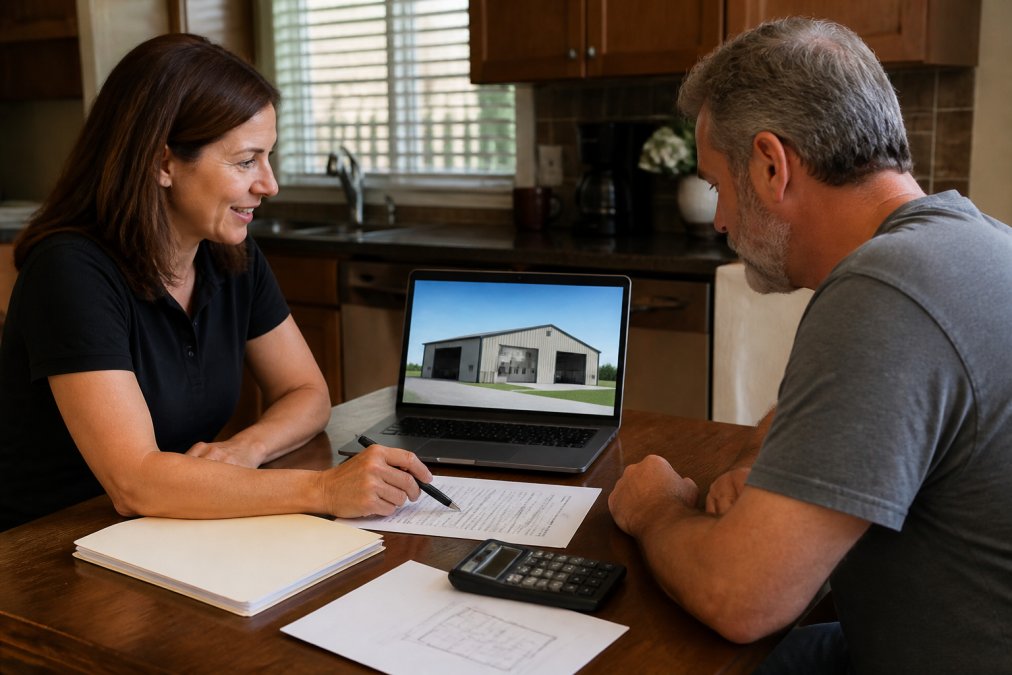
The application process is where most buyers get stuck. The steps below walk you from pre-approval to closing, and the checklist at the end covers the documents lenders ask for most.
- Check your credit score and pull a free credit report.
- Gather income proof, tax returns, and bank statements.
- Get engineered drawings and a written build quote.
- Compare at least three lenders on rate and fees.
- Submit your pre-approval application.
- Review the loan estimate line by line.
- Lock your rate and schedule closing.
- Confirm the draw schedule before work begins.
Documents Lenders Typically Require
- Government-issued photo ID
- Two years of tax returns
- Recent pay stubs or profit-and-loss statements
- Bank statements for the last two to three months
- Purchase agreement or build contract
- Engineered drawings and permit details
- Proof of insurance on the structure
- Land deed or lease, if the building sits on owned property
Credit Score and Pre-Approval Tips
A higher credit score gets you a lower fixed APR. Before you apply, pay down revolving balances and avoid opening new credit lines.
Metal Building Down Payment Requirements and Interest Rates
Down payment expectations for metal buildings vary more than they do for site-built homes because lenders classify the structure differently depending on use. A personal-use shop or garage on owned land often qualifies for the same low-down-payment programs as a primary residence. A commercial or agricultural structure typically requires more equity.
A common pattern among lenders:
- Manufacturer or dealer financing: often no down payment on approved credit for smaller kit purchases, though a deposit is standard once you order.
- Conventional bank loan on a personal-use structure: down payments commonly fall in the 10% to 20% range, driven by the loan-to-value ratio the lender allows.
- SBA loan for an owner-occupied business structure: the SBA's standard 7(a) and 504 programs are designed to reduce down payment requirements, but the borrower still contributes a meaningful equity injection. Confirm current program terms with the lender, since SBA rules are updated periodically.
- Construction-to-permanent loan: expect a larger equity contribution because the lender is funding an unbuilt asset.
How Lenders Set Your Rate
Interest rates on metal building loans track the broader market, but the spread between borrowers comes from four factors:
- Credit score. A higher score gets you a lower fixed APR. The difference between a mid-tier and top-tier score can be meaningful over a 15-year term.
- Loan-to-value ratio. A higher LTV means a smaller down payment but a higher rate, because the lender carries more risk.
- Term length. Longer amortization lowers the monthly payment but raises total interest paid. A 20-year loan can cost substantially more in total interest than a 10-year loan at the same rate.
- Structure classification. A building the lender treats as residential usually prices lower than one classified as commercial.
Fixed vs. Variable APR
A fixed APR protects you from payment shocks over the life of the loan. A variable rate may start lower but can rise with the index it tracks. For a metal building you plan to own for decades, the predictability of a fixed rate is often worth the slightly higher starting point.
Tax and Insurance Costs That Change Your Real Payment
Two costs get ignored until closing, and both affect your true monthly outlay.
Barndominium Construction Loans: What You Need to Know
A barndominium combines living space and shop or garage space under one metal roof. That dual purpose is exactly what makes financing tricky: lenders have to decide whether they are underwriting a home or a commercial building, and that decision drives your rate, your down payment, and which loan programs you can even apply for.
Why Barndominium Loans Are Harder to Place
Not every lender writes them. The field narrows further when the structure includes a large shop, agricultural use, or an unfinished interior. A common pattern is that national banks with rigid appraisal systems decline the file, while regional lenders, farm credit associations, and portfolio lenders who hold loans on their own books are more comfortable with the mixed-use design.
What Lenders Require for a Barndominium Build
Most lenders who write these loans want:
- A licensed general contractor or a builder with verifiable experience on metal structures
- Engineered drawings stamped for your jurisdiction
- A fixed build budget with line-item costs
- A draw schedule tied to completed milestones
- Proof of land ownership or a long-term lease
- Builder's risk insurance during construction, converting to a permanent policy at closing
Some lenders send an inspector before releasing each draw. Foundation, framing, dried-in shell, and mechanical rough-in are common inspection points. A failed inspection can delay your next draw, so build a cushion into your timeline.
Construction-to-Permanent Structure
Many barndominium loans are written as construction-to-permanent: a single closing covers the build phase, then the loan converts to a standard mortgage at completion. During construction you typically pay interest only on the amount drawn. After conversion, you begin full principal-and-interest payments.
Appraisal and Inspection Hurdles
Barndominiums can be hard to appraise because comparable sales are scarce in many markets. Lenders may require a cost-based appraisal or a specialty appraiser familiar with metal structures. Ask upfront whether the lender has closed a barndominium before, a lender learning on your file costs you time.
Affordable Metal Building Kits 2026: Financing Through Manufacturers
Affordable metal building kits 2026 buyers often finance directly through the manufacturer. This route skips the bank and moves faster, but it usually costs more in interest.
Tax Implications and Insurance for Financed Metal Structures
Two costs get ignored until closing: taxes and insurance. Both affect your real monthly outlay.
Regional vs. National Lenders: Which Is Right for You?
Regional lenders know local wind and snow load rules and often close faster on smaller loans. National lenders offer more product variety and consistent processes.
Conclusion
Financing a metal building comes down to matching the loan to your project, your credit, and your timeline. The wrong structure for your needs costs you just as much as the wrong loan.
Frequently Asked Questions
Is it hard to get a loan for a metal building?
It depends on your credit score, down payment, and lender. Banks typically want a credit score of at least 620 and a down payment of 10-20%. SBA loans are more lenient but require more paperwork. Manufacturer financing and rent-to-own options often have easier approval but higher rates. Getting pre-approved helps you know your budget before you shop.
How many years can you finance a metal building?
Terms vary by loan type. Personal loans usually run 3-7 years. Construction loans are short-term (6-18 months) and convert to permanent mortgages of 10-30 years. SBA 504 loans offer up to 20 years. Manufacturer financing is often 5-10 years. Choose a term that keeps monthly payments manageable while minimizing total interest.
What are the typical down payment requirements for metal building financing?
Most lenders require 10-20% down for metal building loans. SBA loans can go as low as 10%, while conventional construction loans often ask for 20%. Manufacturer financing may require 10-15%. A larger down payment lowers your monthly payment and may secure a better interest rate. Some lenders waive down payment for well-qualified borrowers.
Do lenders require engineer-certified plans for building loans?
Yes, most lenders require engineer-certified plans to confirm the structure meets local building codes, wind loads, and snow loads. These plans also protect the lender's collateral. If you buy from a manufacturer, they often provide certified drawings. Without them, your loan application may be delayed or denied. Always ask your builder about certification before applying.