 ultimate-guide
Metal Carport Roof Styles for Heavy Snow: A 2026 Guide
Table of Contents
- Why Metal Carport Roof Style Matters in Snow Country
- Vertical Roof vs. Boxed Eave Carport: Which Handles Snow Better
- Understanding Snow Load Requirements for Metal Buildings
- A-Frame Roof Design for Maximum Snow Protection
- Galvanized Steel Frame Durability and Corrosion Resistance
- Heavy Duty Metal Carports for Sale: What to Look For
- Climate-Specific Considerations and Building Codes
- Maintenance Tips for Heavy Snowfall Regions
- Frequently Asked Questions
Last Updated: October 2, 2026
Why Metal Carport Roof Style Matters in Snow Country
In heavy snow regions, your metal carport roof style determines whether snow sheds safely or accumulates dangerously. The choice between vertical roofs and boxed eaves directly affects snow load capacity, structural longevity, and winter safety.
Metal carport roof styles for heavy snow depend on pitch angle, frame material, and design working together to determine load capacity. At Metal Carport Depot LLC, we've engineered solutions across 37 states that account for regional snow loads, wind patterns, and local building codes.
Vertical Roof vs. Boxed Eave Carport: Which Handles Snow Better
Vertical Roof Advantages for Snow Shedding
A vertical roof slopes steeply (typically 4:12 pitch or steeper) and forces snow to slide off rather than accumulate.
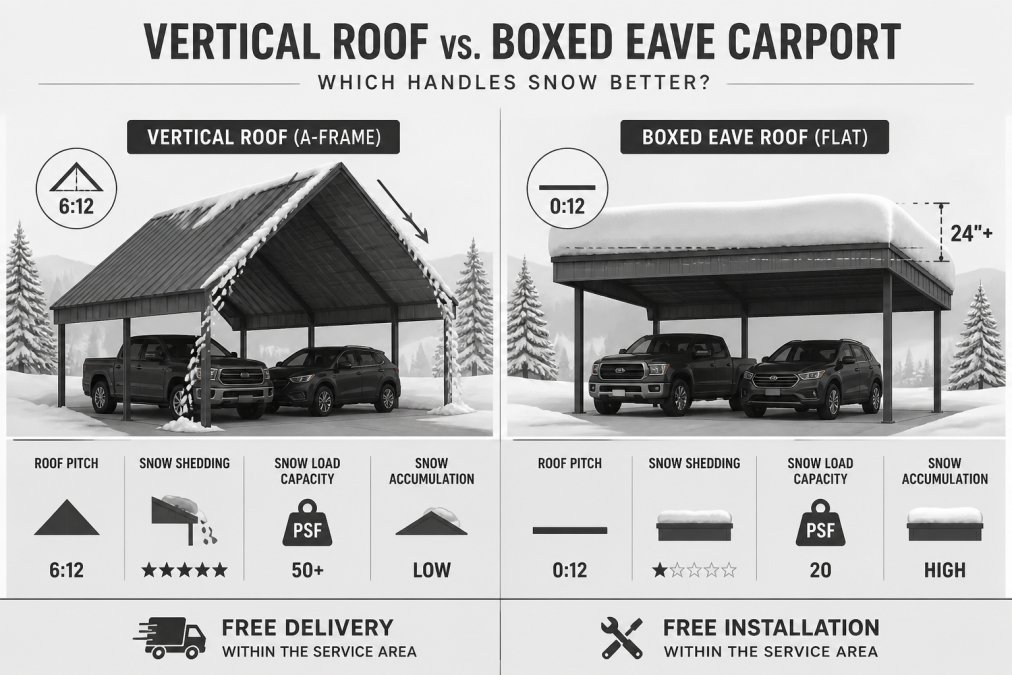
Gravity pulls snow downward, shedding weight continuously and reducing the total load the frame must support.
Snow shedding becomes effective at 4:12 pitch and faster at steeper angles (6:12, 8:12). Shallow slopes lack sufficient gravitational force to overcome friction between snow layers.
[IMAGE: Two metal carports side-by-side in winter landscape, one with steep A-frame roof shedding snow cleanly, one with flat boxed eave design showing heavy snow accumulation | section:Vertical Roof vs.
The trade-off is interior headroom. An A-frame carport with a 4:12 pitch loses about 18-24 inches of ceiling height at the center compared to a flat design.
Boxed Eave Design: Trade-offs and Best Uses
A boxed eave carport has a flat roof with vertical support columns on all four sides, creating uniform headroom and maximizing usable space for RVs, boats, or tall equipment.
In heavy snow climates, snow accumulates on boxed eaves. A boxed eave roof in a 100 PSF zone collects the full load across the surface, requiring thicker steel tubing, closer rafter spacing, and stronger anchoring systems.
Boxed eaves work best in moderate climates or where you actively remove snow. In heavy snow regions without maintenance, boxed eaves require significantly heavier structural reinforcement than vertical roofs.
Understanding Snow Load Requirements for Metal Buildings
Ground Snow Load and PSF Ratings Explained
Ground snow load is the weight of snow accumulating on a horizontal surface during the heaviest typical snow event in your area, measured in pounds per square foot (PSF).
A 50 PSF ground snow load means a 1-foot-by-1-foot horizontal surface supports 50 pounds of snow. A 20-by-30-foot carport roof faces 300,000 pounds of potential snow weight at 50 PSF.
Building codes specify ground snow load for your location via International Building Code (IBC) maps or your local building department. Metal carport roof styles for heavy snow must be rated for your specific PSF requirement.
The rating appears in engineering documents as "design snow load" or "roof snow load," always higher than ground snow load because pitch, exposure, and thermal conditions affect snow settlement.
How Roof Pitch and Angle Affect Snow Accumulation
Roof pitch (e.g., 4:12 means 4 inches of rise per 12 inches of horizontal run) directly determines how much snow stays on your carport.
A flat roof (0:12) holds all snow. A 2:12 pitch sheds slightly. At 4:12, meaningful shedding begins. At 8:12 or steeper, most snow slides off during storms.
The relationship isn't linear. The difference between 4:12 and 6:12 is substantial.
Pitch interacts with snow type. Wet, heavy snow doesn't slide as easily as dry snow. In regions with mixed snow types, engineers recommend steeper pitches (6:12 or higher) to ensure shedding across all conditions.
A-Frame Roof Design for Maximum Snow Protection
An A-frame roof has two symmetrical slopes meeting at a peak, offering maximum snow-shedding benefit. Snow slides down both sides simultaneously, distributing the load evenly.
A-frame designs excel where ground snow load exceeds 80 PSF. The steep pitch (6:12 to 8:12) ensures heavy, wet snow sheds before accumulation becomes dangerous. The symmetrical design also handles wind load better.
Because snow sheds continuously, the frame doesn't need to support the full ground snow load. Lighter-gauge steel tubing can be used compared to boxed eave structures in the same zone, reducing material costs.
The primary limitation is interior space. An A-frame carport is narrowest at the peak. If you need maximum center headroom, a boxed eave requires heavier structural reinforcement.
Galvanized Steel Frame Durability and Corrosion Resistance
Metal carport frames are built from galvanized steel tubing, steel coated with zinc to protect against rust and corrosion.
Zinc acts as a physical barrier preventing moisture and oxygen from reaching steel.
Galvanized steel frames last 50+ years in most climates, including heavy snow and freeze-thaw regions. Quality of the galvanizing process and zinc coating thickness determine longevity in harsh environments.
Corrosion resistance is critical in heavy snow regions because freeze-thaw cycles accelerate rust. Water accumulates in joints, freezes, and creates stress points where corrosion begins.
Galvanized steel tubing maintains structural integrity through temperature extremes and snow load conditions, which is why it's the standard material for metal carports.
Heavy Duty Metal Carports for Sale: What to Look For
Structural Gauge and Load-Bearing Capacity
When evaluating heavy duty metal carports for sale, examine structural gauge, the thickness of steel tubing measured in thousandths of an inch. Common gauges range from 16 (thinner) to 12 (thicker).
A 16-gauge frame handles lighter snow loads at lower cost. A 12-gauge frame supports significantly higher loads. For heavy snow regions, 12-gauge or 14-gauge is standard.
Load-bearing capacity is the maximum roof snow load the structure can safely support, measured in PSF. This rating accounts for gauge, support spacing, roof pitch, and anchoring.
The rating should appear in engineering drawings or specifications. Never estimate capacity based on appearance. A well-engineered carport with proper pitch and reinforcement might handle your snow load with thinner gauge material than expected.
Reinforcement Options and Anchoring Systems
Reinforcement options strengthen a carport to handle higher snow loads. Common approaches include diagonal bracing, increased rafter spacing, or additional support columns.
Diagonal bracing (X-bracing) runs corner to corner, creating triangular shapes that distribute loads efficiently. This is especially valuable in regions with both heavy snow and high wind loads.
Anchoring systems determine how the carport attaches to the ground. The two primary approaches are concrete footings (digging 3-4 feet deep and setting posts in concrete) and ground anchors.
Ground anchors use metal cables or straps attached to buried anchor points. This works where deep footings aren't feasible or temporary installation is desired.
For heavy snow regions, concrete footings are standard. They prevent wind uplift and provide stable support for snow loads.
| Reinforcement Type | Best For | Load Increase | Cost Impact |
|---|---|---|---|
| Diagonal Bracing | High wind + snow zones | 15-25% | Moderate |
| Extra Support Posts | Heavy snow zones | 20-30% | Moderate |
| Thicker Gauge Tubing | All applications | 40-60% | Significant |
| Deeper Concrete Footings | Freeze-thaw regions | Stability improvement | Moderate |
Climate-Specific Considerations and Building Codes
Your regional building code specifies the snow load your carport must handle. Building codes vary by state and sometimes by county.
To find your snow load requirement, contact your local building department or check the IBC snow load maps for your specific location. These maps divide regions into zones based on historical snowfall data.
Wind load is equally important. Coastal regions and high-elevation areas face higher wind pressures.
Building codes also specify minimum roof pitch for certain snow zones. Some jurisdictions require a minimum 4:12 pitch in heavy snow areas to ensure adequate shedding.
Permit requirements vary. Some jurisdictions require permits for any structure over a certain size. Others require permits only for enclosed buildings.
Maintenance Tips for Heavy Snowfall Regions
Regular maintenance extends carport life and prevents snow-load emergencies.
After each significant snowfall, visually inspect the roof for snow accumulation depth.
For boxed eave carports, regular snow removal is essential. Accumulated snow becomes heavier as it ages and compacts.
Inspect the galvanized coating annually for damage.
Check anchoring systems and concrete footings in spring after freeze-thaw cycles.
Clear gutters and downspouts regularly if your carport has them.
Metal carport roof styles for heavy snow demand careful matching between design, materials, and regional conditions.
At Metal Carport Depot LLC, we engineer every structure to your specific snow load, wind load, and local building code requirements.
Get started with Metal Carport Depot LLC and configure your snow-rated carport with our instant, state-specific pricing tool.
Frequently Asked Questions
What type of carport roof is best for handling heavy snow?
Vertical and A-frame metal carport roofs are superior for heavy snow because their steep pitch sheds accumulation quickly, preventing dangerous loads from building up. A vertical roof typically handles steeper angles (45 degrees or more), allowing snow to slide off naturally. Boxed eave designs are flatter and retain more snow, making them less ideal for regions with frequent heavy snowfall. The best choice depends on your ground snow load rating in PSF and local building codes.
How many pounds per square foot (PSF) should a metal carport handle in heavy snow areas?
Snow load requirements vary by region. Most areas with significant snowfall require carports rated for 30-50 PSF, while alpine or extreme-weather zones may need 75+ PSF. Your local building department provides ground snow load maps that specify the design load for your exact location. Metal carports must be engineered to meet or exceed these standards. Always verify your region's requirements before purchasing, as undersized structures can fail under heavy accumulation.
Does roof pitch really affect how much snow a metal carport can hold?
Yes, roof pitch is critical. A steeper pitch (45 degrees or higher) sheds snow faster and reduces the total load on the structure. A shallow pitch (under 20 degrees) allows snow to accumulate, increasing structural stress. For every 10-degree increase in pitch, snow shedding improves significantly. In heavy-snow regions, a steep vertical or A-frame design is essential for both safety and structural longevity. Flat or low-pitch roofs require heavier-gauge steel and more frequent snow removal.
Why do metal carports need galvanized steel in snowy climates?
Galvanized steel has a protective zinc coating that prevents rust and corrosion, especially critical in snowy regions where salt, moisture, and freeze-thaw cycles accelerate metal degradation. Without galvanization, bare steel exposed to snow melt and road salt will corrode within a few years. Galvanized framing extends the lifespan of your carport by 20+ years and maintains structural integrity through harsh winters. Always specify galvanized steel tubing and panels for any metal carport in heavy-snow areas.