 ultimate-guide
Does a Carport Add Value to Your Home? (2026 Insights)
Table of Contents
- Does a Carport Add Value to Your Home? The Short Answer
- Carport vs Garage Resale Value: Which Offers Better ROI?
- Benefits of Installing a Metal Carport for Home Equity
- Key Factors That Determine How Much Value a Carport Adds
- Carport Installation Permits and Regulations: What to Know
- Climate, Insurance, and EV Charging: ROI Angles Most Guides Miss
- Conclusion: Is a Carport a Smart Investment for Your Property?
- Frequently Asked Questions
Last Updated: September 7, 2026
Does a Carport Add Value to Your Home? The Short Answer
Yes, a carport can add value to your home, but the amount depends heavily on how it's built, where you live, and what buyers in your market actually want, and understanding how a carport add value in your specific area is the first step. A well-designed carport adds value to home with carport buyers by providing covered parking, protecting vehicles from weather, and extending the usable life of the cars themselves. At Metal Carport Depot LLC, our engineer-certified metal structures are professionally installed and designed to match your home's aesthetic.
The key distinction homeowners miss is that a carport is not a garage. It won't add the same dollar-for-dollar return as a fully enclosed space, but it costs a fraction to install. The real question isn't whether it adds value, it's whether the value it adds exceeds the cost of installation in your specific market.
Carport vs Garage Resale Value: Which Offers Better ROI?
Garages typically deliver a higher return on investment than carports because buyers perceive an enclosed, secure space as more versatile. A garage functions as storage, a workshop, or even a future conversion project. A carport, by contrast, offers weather protection and covered parking without the security of four walls and a locking door.
That said, the ROI gap narrows considerably when you factor in installation costs. Building a garage can cost several times more than a quality metal carport, and that higher upfront investment doesn't always translate to proportionally higher resale value. For many homeowners, the carport represents the smarter financial move because it captures most of the curb appeal benefit at a fraction of the cost.
| Feature | Carport | Garage |
|---|---|---|
| Relative cost | Lower upfront investment | Significantly higher cost |
| Security | Open, no locking door | Enclosed and lockable |
| Resale perception | Covered parking, weather protection | Storage, workshop, security |
| Installation time | Days, not weeks | Weeks to months |
| Best for | Budget-conscious, RV/boat owners | Buyers wanting enclosed space |
Benefits of Installing a Metal Carport for Home Equity
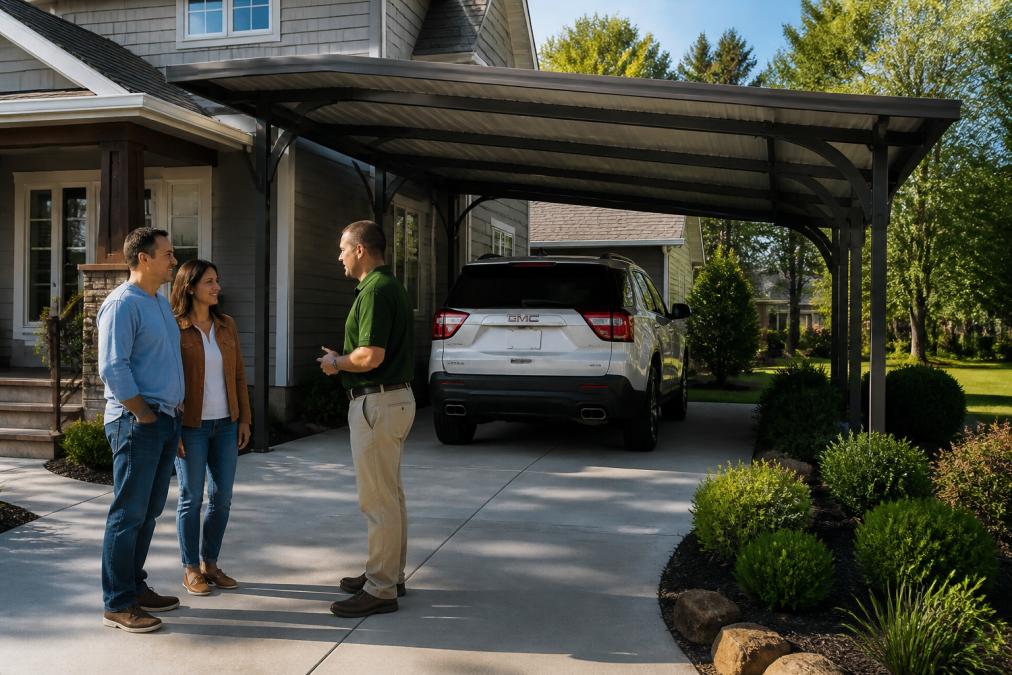
A metal carport builds home equity by protecting your vehicles, which are often the second-largest investment a household makes. Shielding a car, RV, or boat from UV damage, hail, and snow reduces wear on paint, seals, and interiors, which extends vehicle longevity and preserves its resale value. Buyers recognize this practical benefit even if they don't say it aloud.
Metal structures also outlast wood alternatives with far less long-term maintenance. Galvanized steel framing resists rot, pests, and warping, meaning the structure itself won't become a liability that drags down your property value. A properly anchored metal carport is a permanent improvement, not a temporary fix.
Key Factors That Determine How Much Value a Carport Adds
Location and climate drive the return on a carport more than any other factor. In regions with harsh winters, scorching summers, or frequent hailstorms, covered parking is nearly essential. In temperate climates where weather damage is minimal, buyers may see a carport as a nice-to-have rather than a must-have, which reduces the value it adds. metal home improvements.
The structure's quality matters just as much. A professionally installed, engineer-certified metal carport with proper foundation requirements and permit compliance signals durability to an appraiser. A DIY structure with questionable structural integrity can actually hurt resale value because buyers worry about the cost of fixing or removing it. Material durability, architectural style, and how well the structure integrates with the home's existing design all influence buyer perception.
Carport Installation Permits and Regulations: What to Know
Building permits and zoning laws vary by municipality, and failing to secure them can create serious problems at closing. Most areas require a permit for any permanent detached structure, and some have restrictions on placement, height, and how close a carport can sit to property lines. Selling a home with an unpermitted structure can delay or derail a sale entirely.
Before installation, check your local zoning laws and confirm whether your property has any easements or setbacks that would affect placement. An engineered drawing, which shows the structure meets local wind and snow load requirements, is often required for permit approval. Working with a provider that supplies these documents simplifies the process considerably.
Climate, Insurance, and EV Charging: ROI Angles Most Guides Miss
Most discussions of carport value ignore three factors that meaningfully affect return: climate-specific ROI, insurance premiums, and EV charging integration.
In snow-heavy or hail-prone regions, the weather protection a carport provides can reduce claims on vehicles and sometimes lower insurance premiums for covered parking. It's worth asking your insurer whether a carport qualifies for a discount, since the answer varies by carrier and state. Insurance Information Institute guidance on discounts notes that many carriers offer premium reductions for vehicles stored under cover.
Electric vehicle owners have an additional angle. A carport with a dedicated EV charging station is increasingly attractive to buyers, particularly in markets where EV adoption is growing. The combination of covered parking and charging infrastructure addresses two concerns at once: weather protection for the vehicle and a functional space for charging. U.S. Department of Energy resources on EV charging infrastructure highlights how home charging accessibility influences EV ownership decisions.
The climate factor is straightforward. FEMA guidance on protecting property from severe weather emphasizes that protective structures reduce weather-related damage, which is exactly what a carport does for vehicles in storm-prone areas. Buyers in these regions understand this intuitively, making the carport a more compelling feature during resale.
Conclusion: Is a Carport a Smart Investment for Your Property?
A carport is a smart investment when it's properly permitted, professionally installed, and suited to your climate and buyer market. It won't match a garage's raw resale value, but it delivers strong practical benefits at a lower cost, making it an attractive option for homeowners who want weather protection without the expense of a full enclosure.
At Metal Carport Depot LLC, we supply engineer-certified metal structures with custom sizing at no extra charge, and our team handles delivery and professional installation across 37 states. Every structure is certified for local wind and snow loads, and we provide engineered drawings to support your permit application. Our 3D design tool gives you instant, state-specific pricing so you know exactly what you're paying before you commit.
Call 1-800-324-5315 to get started with a custom carport that protects your vehicles and strengthens your property's value.
Frequently Asked Questions
How much does a carport increase home value?
A carport can add value, but the increase varies widely based on your market and the structure's quality. Appraisers often view it as a covered parking amenity that boosts curb appeal and functional space, though it typically adds less value than a fully enclosed garage. The material, foundation, and design matter. A well-built metal carport that complements your home and meets local zoning laws is more likely to yield a solid return on investment than a temporary or poorly anchored structure.
Is a metal carport considered a permanent structure for appraisal?
Whether an appraiser considers a metal carport a permanent structure depends on its foundation and anchoring. A carport set on a concrete slab with proper anchors is more likely to be valued as a permanent improvement. Portable or unanchored units are often classified as personal property. For the best chance of adding to your home's appraised value, ensure your carport is professionally installed on a proper foundation and meets local building codes for structural integrity.
Does adding a carport increase property taxes?
Adding a carport can increase your property taxes because it is a home improvement that may raise your property's assessed value. The exact impact depends on your local tax assessor's rules. Since a carport requires a building permit in most areas, the permit process often triggers a reassessment. Contact your local tax office to understand how they handle detached and attached structures before you build, so there are no surprises on your next tax bill.
What are the benefits of a carport over a traditional garage?
Carports offer several advantages over a traditional garage, primarily lower installation costs and faster setup. They provide essential weather protection for your vehicle against sun, hail, and snow, which helps prevent UV damage and preserves your car's finish. A metal carport can also serve as a versatile outdoor living space for gatherings. While a garage offers more security and storage, a carport is a budget-friendly way to add covered parking and functional space to your property.