 blog
blog
Is Rent to Own Worth It for Carports? 2026 Guide
Table of Contents
- How Rent-to-Own Carports Work
- Rent-to-Own vs. Financing a Carport: Which Contract Fits You
- Rent-to-Own Carport Payment Terms You Need to Read Twice
- Rent-to-Own vs. Paying Cash: The Total Cost Comparison
- Carport Installation and Permits: What the Contract Does Not Cover
- Carport Ownership and Property Value After Your Final Payment
- Is Rent to Own Worth It for Carports? A Decision Framework
- Conclusion
- Frequently Asked Questions
Last Updated: October 12, 2026
How Rent-to-Own Carports Work
Rent-to-own carports are payment plans that let you use a structure immediately while paying it off over time. Instead of paying the full purchase price upfront, you make manageable monthly payments until you own the structure outright.
The mechanics are straightforward. You choose a design, sign a contract that sets your payment term, and the carport gets delivered and installed. You use it right away. Once your final payment clears, ownership transfers to you.
What You Pay Upfront and What You Owe Monthly
Most rent-to-own agreements require a down payment or security deposit at signing, then a fixed monthly payment for a set term.
Monthly payment amounts depend on three things: the total purchase price of your structure, your term length, and the down payment you put down.
What catches people off guard is that your monthly payment covers the structure only. Site preparation, concrete pads, and permits are usually separate costs you handle yourself.
Rent-to-Own vs. Financing a Carport: Which Contract Fits You
Rent-to-own and traditional financing both spread your cost over time, but they work differently. Rent-to-own typically requires no credit check or a lighter approval process. Traditional financing through a bank or lender usually involves a credit check, proof of income, and a formal loan agreement with an interest rate.
The right choice depends on your credit situation and how fast you want to own the structure.
| Factor | Rent-to-Own | Traditional Financing |
|---|---|---|
| Credit check | Often none or lenient | Standard credit check |
| Approval speed | Fast, sometimes instant | Days to weeks |
| Down payment | Usually required | Varies by lender |
| Ownership | Transfers after final payment | Transfers at purchase |
| Total cost | Often higher | Often lower |
Credit Checks, Approval, and Eligibility
Many rent-to-own carport programs advertise no credit check or instant approval. That access comes at a cost: you may pay more in total than a buyer with strong credit who qualifies for a low-interest loan.
If your credit is solid, compare a traditional loan first. If your credit is thin or you need the structure fast, rent-to-own removes the approval barrier.
Rent-to-Own Carport Payment Terms You Need to Read Twice
Payment terms are where rent-to-own contracts earn their reputation for fine print. The term length, the total of your payments, and the conditions around missed payments all live in this section of the agreement. Most competitors stop at "read the fine print." That advice is useless without knowing which clauses actually change your outcome. Here are the four terms that decide whether a rent-to-own carport is worth it for you.
Term Length and Total of Payments
A common structure is a fixed term measured in months with equal payments. The total you pay over the term will exceed the sticker price of the structure. That difference is the cost of spreading payments out and taking on lighter approval requirements. Before you sign, ask the seller to write the total of payments on the contract, not just the monthly figure.
Early Payoff: What You Owe If You Pay Ahead
Early payoff rules vary widely, and this is the clause most buyers never read. Three common patterns exist:
- No penalty, simple payoff. You request a payoff quote, pay the remaining balance, and own the structure. This is the most consumer-friendly structure.
- Precomputed interest. The contract calculates interest for the full term up front. Paying early does not reduce what you owe, you pay the same total whether you finish in six months or thirty-six.
- Early payoff fee. Some agreements charge a flat fee or a percentage to close out the balance ahead of schedule.
Ask specifically: "If I pay this off in six months, what is my exact payoff amount, and is there a fee?" Get the answer in writing. If the seller will not put it in writing, treat that as a deal-breaker.
Missed Payments, Late Fees, and Repossession
Missed payments are the riskiest part of any rent-to-own deal. Consequences typically escalate in stages: a grace period, then a late fee, then a default notice, and finally repossession of the structure. Repossession means the carport is removed from your property, and in most agreements, payments already made are not refunded. Read the default clause to learn the grace period length, the late fee amount, and how many missed payments trigger repossession.
Cancellation and Return
If you cancel mid-term, you may lose your down payment and any payments already made. Some contracts allow a voluntary return with a restocking or removal fee; others treat cancellation as default. The cancellation clause should state plainly what you get back, if anything, and who pays for removal. If it does not, ask before signing.
Questions to Ask Before You Sign
Use this checklist to compare any rent-to-own agreement against another:
- What is the total of payments over the full term?
- What is my exact early payoff amount, and is there a penalty?
- What is the grace period, and what is the late fee?
- How many missed payments trigger repossession?
- If I cancel or return the structure, what do I lose?
- Is the payment schedule in writing?
Rent-to-Own vs. Paying Cash: The Total Cost Comparison
Paying cash is almost always cheaper in total dollars. You avoid interest, fees, and the markup built into rent-to-own pricing. But "cheaper" is not a number, and the monthly payment is not your project cost. Here is how to compare the two paths honestly.
A Worked Comparison Framework
Because prices vary by size, region, and configuration, use this framework with your own quotes rather than a single sticker figure:
| Line item | Cash purchase | Rent-to-own |
|---|---|---|
| Structure price | Full price at signing | Full price plus financing markup |
| Down payment | None | Required at signing |
| Monthly payment | None | Fixed for the term |
| Total of payments | Equals structure price | Exceeds structure price |
| Site prep and concrete | You pay | You pay |
| Permits | You pay | You pay |
| Delivery and installation | Included in service area | Included in service area |
To run your own comparison, add the down payment to the total of payments on the rent-to-own contract, then subtract the cash price. The difference is your financing premium. Divide that premium by the number of months you will use the structure to see your true monthly cost of access.
The Costs the Monthly Payment Does Not Cover
Your rent-to-own payment covers the structure and its delivery and installation within the service area. It usually does not cover site preparation, concrete, or permit fees. Those are separate line items, and they can add meaningful cost to your project:
- Site preparation. A carport needs a level, properly anchored base. Depending on your soil and local requirements, that may mean a concrete pad, gravel, or ground anchors.
- Concrete. A poured pad is often the largest single add-on. Cost scales with the size of the structure.
- Permits. Many jurisdictions require a building permit for a carport, especially larger structures. Engineered drawings help here, and we provide those for permit applications.
Because these costs apply whether you pay cash or finance, they do not change which payment method is cheaper, but they do change whether the project fits your budget at all. Budget for them separately before you commit to any payment plan.
When the Premium Is Worth It
The honest comparison comes down to this: rent-to-own costs more overall, but it lowers the upfront barrier. Whether that premium is worth it depends on how much you value immediate use and how much cash you have on hand. If you need covered storage today and cannot fund the full purchase plus site work, the premium buys you time and access.
Carport Installation and Permits: What the Contract Does Not Cover
Your rent-to-own payment covers the structure and its delivery and installation. It usually does not cover site preparation, concrete, or permit fees.
Site preparation matters more than most buyers expect. A carport needs a level, properly anchored base.
Permits are another cost the contract leaves out. Many jurisdictions require a building permit for a carport, especially larger structures. Engineered drawings help here, and we provide those for permit applications.
Carport Ownership and Property Value After Your Final Payment
Once you make your final payment, ownership transfers to you and the structure becomes part of your property.
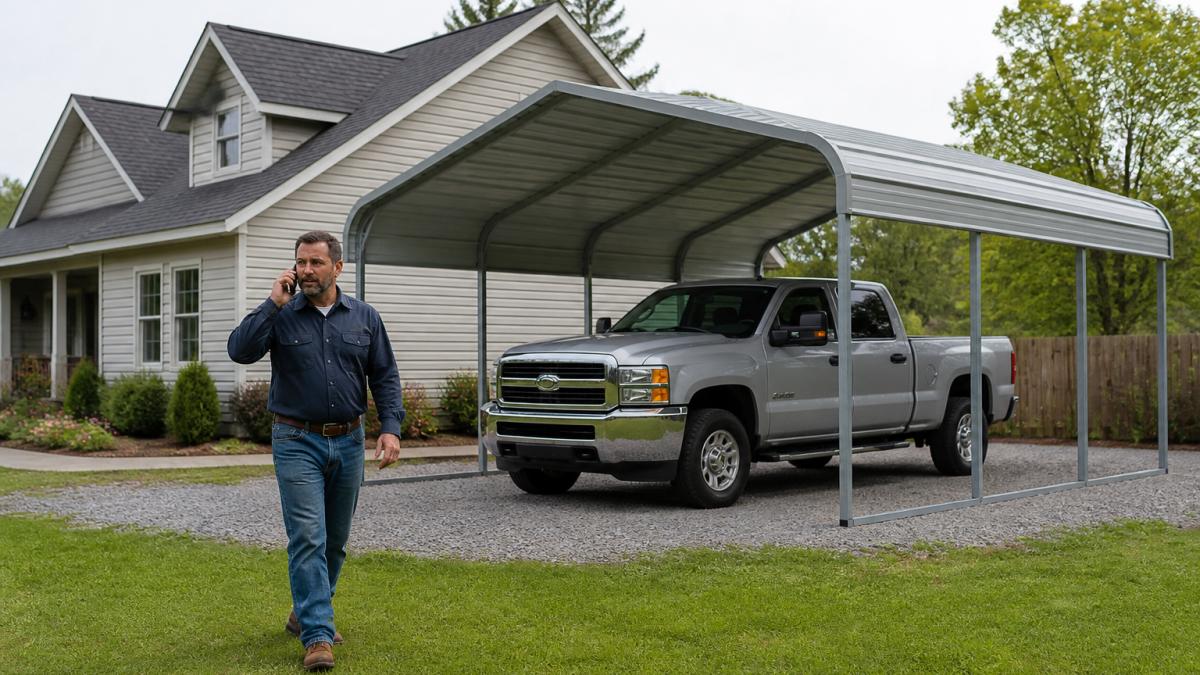
Taxes and consumer protections matter at this stage. Adding a permanent structure may affect your property assessment, so check with your local tax authority.
Durability plays into long-term value. Galvanized steel framing resists rust and holds up to weather when it is properly anchored.
Is Rent to Own Worth It for Carports? A Decision Framework
Is rent to own worth it for carports? It depends on your time horizon, your cash position, and your credit. Use this framework to decide.
- Choose rent-to-own if: you need covered storage now, you have limited cash for a full purchase, or your credit makes traditional financing hard to get.
- Choose traditional financing if: your credit is strong and you want a lower total cost with formal loan terms.
- Choose cash if: you have the funds and can wait, because it is the cheapest path overall.
- Walk away if: the contract hides early payoff penalties, will not provide a payment schedule, or the total cost is far above the structure's value.
The decision comes down to what you are optimizing for. Lowest total cost points to cash. Fastest access with the least paperwork points to rent-to-own.
Conclusion
Choosing how to pay for a carport is a real decision, and the wrong contract can cost you more than the structure is worth. At Metal Carport Depot LLC, we make it simpler with rent-to-own and financing options, free delivery and professional installation in 37 states, custom sizes at no extra charge, and engineered drawings for your permit applications. Get started with Metal Carport Depot LLC and protect your property with a structure built to last.
Frequently Asked Questions
Is rent-to-own ever a good idea for a carport?
It can be, if you need the structure now and cannot pay the full amount upfront. Rent-to-own carports spread the cost into monthly payments with a low upfront payment, and you use the carport while you pay. The trade-off is that the total cost is usually higher than a cash purchase, and the contract ties you to a fixed term. Read the payment term, early payoff clause, and cancellation rules before signing, then compare the total against paying cash or traditional financing.
What happens if you miss a rent-to-own carport payment?
Missed payment consequences are set by the contract, not by a universal rule, so the exact outcome depends on your agreement. Common terms allow a grace period, then a late fee, and repeated misses can lead to default and possible repossession of the structure. Before you sign, ask the dealer to write out the grace period, the late fee amount, and what triggers default. If your income varies month to month, choose a term that keeps payments manageable.
Can you pay off a rent-to-own carport early?
Many rent-to-own agreements allow early payoff, and some reduce the remaining balance if you pay ahead of schedule. Others charge the full scheduled amount regardless of when you finish. Ask for the early payoff terms in writing before signing, including whether any discount applies and how the payoff figure is calculated. Paying early is usually the fastest way to cut the total cost of a rent-to-own carport below the sticker total.
Do you own the carport during the payment term or only at the end?
With most rent-to-own carport contracts, ownership transfers only after you make the final scheduled payment. Until then the structure is rented, even though it sits on your property and you use it daily. That distinction matters for taxes, insurance, and what happens if you cancel. Ask when the title or bill of sale is issued and get that date in writing. Once ownership transfers, the structure becomes part of your property and can add usable, covered storage that buyers value.