 ultimate-guide
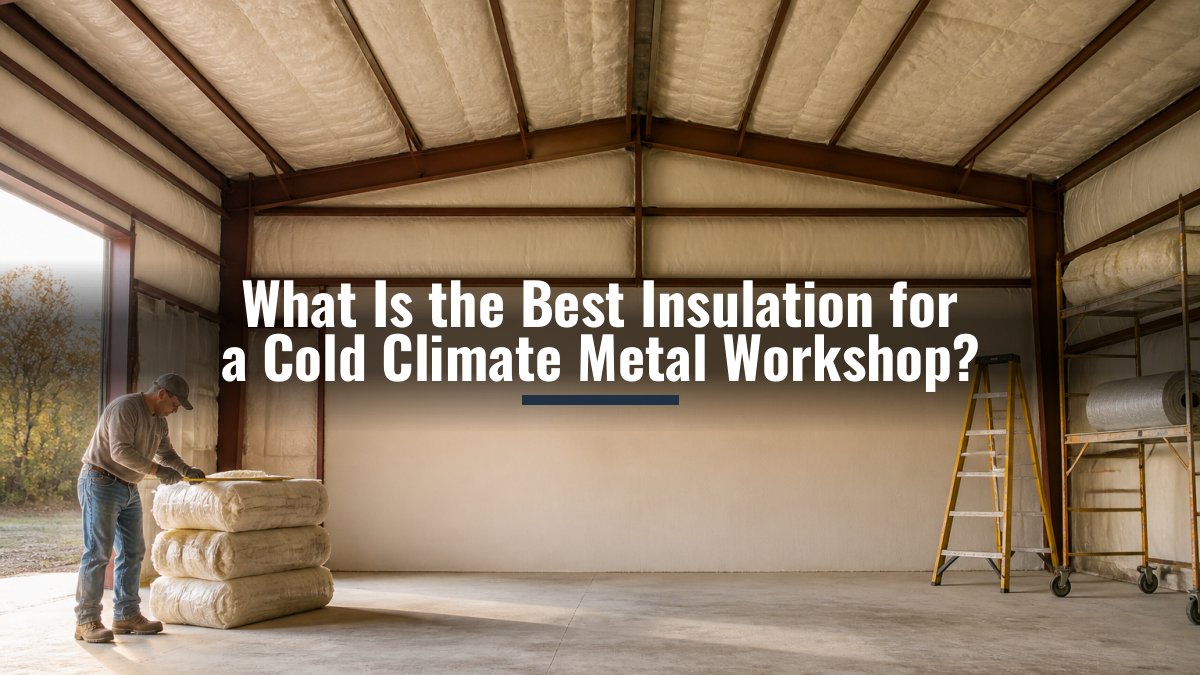
What Is the Best Insulation for a Cold Climate Metal Workshop?
Last Updated: October 29, 2026
Quick Summary
Closed-cell spray foam is the best metal building insulation for cold-climate workshops because it seals air leaks and acts as a vapor retarder in one application, stopping moist air from reaching cold steel. Pair it with continuous insulation over purlins and girts to break thermal bridging, and insulate the roof plane first.
- Air seal gaps at doors, vents, and penetrations before installing any insulation in a retrofit.
- Fix leaks and condensation sources first, since wet insulation loses most of its R-value.
- Prioritize roof insulation, because heat rises and roof area is large.
- Insulate the slab edge in cold climates to stop heat loss and base-of-wall condensation.
- Keep the vapor retarder on the warm interior side and let the assembly dry outward.
Table of Contents
- Why Cold-Climate Workshops Need Different Insulation
- Metal Building Insulation R-Value: What Actually Matters
- Fiberglass Blanket and Batt Insulation
- Spray Foam Insulation for Metal Buildings
- Rigid Foam Board, Reflective Barriers, and Bubble Insulation
- Metal Building Condensation Control and Vapor Strategy
- Insulating an Existing Metal Workshop: Retrofit Steps
- Plan Your Workshop Build With Metal Carport Depot LLC
- Frequently Asked Questions
Why Cold-Climate Workshops Need Different Insulation
A metal workshop in a cold climate is a different building problem than the same shell in a mild one.
Metal building insulation is the layer that slows heat loss through the roof and walls, controls surface condensation, and makes the space usable in winter.
Here is the part most guides skip.
Below, we break down every major insulation type, where each fits, and how to plan the assembly so it performs.
Metal Building Insulation R-Value: What Actually Matters
R-value is a measure of thermal resistance: higher numbers mean slower heat transfer through a material. It is the single most quoted number in insulation shopping, and the single most misunderstood.
The number on a product label describes the material in a lab, not the assembly in your building. What keeps a workshop warm is the whole assembly: insulation, air barrier sealing, and how the material handles moisture over time.
Effective R-Value vs. Nominal R-Value
Nominal R-value is the label number. Effective R-value is what the wall or roof actually delivers after framing, fasteners, gaps, and compression are counted. In a steel building the gap between the two can be large because steel is an excellent conductor, and the effective R-value of a cavity-only assembly often lands well below the nominal rating once purlin and girt bridging is counted.
Three mechanisms drive that gap:
- Thermal bridging. Steel purlins, girts, and fasteners conduct heat straight through the envelope. Continuous insulation layers that break those paths outperform insulation stuffed between members.
- Compression. Fiberglass blanket compressed at purlins or behind panels loses R-value in proportion to how much it is squeezed. A blanket rated at R-19 that is compressed to half its thickness does not deliver R-19.
- Air leakage. Air moving through gaps carries far more heat than the wall itself. A tight assembly with moderate R-value routinely outperforms a high-R assembly with leaky seams.
Whole-Assembly R-Value Targets by Climate Zone
The International Energy Conservation Code (IECC) sets minimum envelope requirements by climate zone, and most jurisdictions adopt some version of it. Cold-climate workshops generally fall in zones 5 through 8, where the code pushes toward higher ceiling and wall R-values and toward continuous insulation. The exact target depends on your adopted code version, conditioned floor area, and whether the shop is conditioned or semi-heated.
Rather than chase a single product number, plan the assembly to hit a whole-assembly target:
- Roof or ceiling: the highest-leverage surface in a shop, because heat rises and roof area is large. Prioritize continuous insulation here.
- Walls: pair cavity insulation with a continuous layer over purlins and girts where budget allows.
- Slab edge and foundation: a cold slab wicks heat out of the shop and drives condensation at the base of walls. Insulate the slab edge in cold climates.
Heating Pattern Changes the Target
A shop heated a few hours at a time needs the envelope to hold warmth after the heater cycles off, which favors assemblies with real mass and tight air sealing over thin reflective products. A continuously heated shop can justify higher-R assemblies because savings compound over the season. Intermittent shops should weight air sealing and warm-up performance heavily, because every cold start re-heats the building mass and the air.
Fiberglass Blanket and Batt Insulation
Fiberglass is the default for metal buildings: widely available, familiar to installers, and among the more cost-effective options for cold-weather workshops. Two forms dominate.
Where fiberglass wins: budget, speed, and compatibility with standard metal building construction. Where it falls short: it must stay dry and uncompressed to perform. Moisture trapped in the blanket kills its thermal resistance and can corrode the steel it touches.
- Best for: new builds, budget-conscious shops, walls where a vinyl-faced blanket doubles as the interior liner
- Watch for: compression at purlins, gaps at penetrations, and any path for moist interior air to reach the cold side
Spray Foam Insulation for Metal Buildings
Spray foam insulation for metal buildings solves the problem fiberglass struggles with: air sealing. Closed-cell spray foam expands into gaps, bonds to the steel, and forms its own air barrier and vapor retarder in a single application.
That combination is why closed-cell spray polyurethane foam is frequently recommended for cold climates.
The trade-offs are real. Spray foam costs more per installed area than fiberglass, requires a professional applicator, and makes future electrical or plumbing changes harder because the cavity is sealed.
- Best for: cold climates, tight buildings, shops where air sealing matters more than budget
- Skip if: you are insulating on a tight budget or need to keep wall cavities accessible
Rigid Foam Board, Reflective Barriers, and Bubble Insulation
Rigid foam board installs as a continuous layer, which makes it strong at breaking thermal bridging.
Reflective insulation and radiant barriers reflect radiant heat rather than slowing conduction. A reflective radiant barrier with foam core combines the two.
Here is where owners get burned. Reflective products have thin conductive R-values. Their performance depends on facing an air space and staying clean and shiny.
| Insulation Type | Best For | Main Strength | Main Limitation |
|---|---|---|---|
| Fiberglass blanket / batt | New builds, budget shops | Cost, availability, vinyl facing | Loses R-value if wet or compressed |
| Closed-cell spray foam | Cold climates, air sealing | Air barrier + vapor retarder in one | Higher cost, pro installation |
| Rigid foam board | Continuous layer, thermal bridging | Breaks framing heat paths | Needs careful joint sealing |
| Reflective / radiant barrier | Supplement over other insulation | Reflects radiant heat | Low conductive R-value alone |
| Bubble insulation | Budget wraps, ceilings | Low cost, easy to install | Thin performance, not a standalone solution |
Metal Building Condensation Control and Vapor Strategy
Metal building condensation control comes down to one rule: keep moist interior air from reaching cold steel.
The vapor strategy depends on the assembly. In a cold climate, the vapor retarder belongs on the warm interior side, and the assembly must be able to dry outward.
Air leakage is the accomplice. If you are comparing roof profiles for a snowy site, our comparison of vertical roof vs boxed eave carports for heavy snow covers how each handles snow and moisture.
Insulating an Existing Metal Workshop: Retrofit Steps
Insulating an existing metal workshop follows a different sequence than a new build, because you are working around an existing interior, existing wiring, and existing moisture problems. The order below is the one that avoids rework, and it is the sequence most product roundups skip.
Step 1: Air Seal Before You Insulate
Air sealing is the highest-return step in any retrofit, and it must come first. Close gaps at the slab edge, doors, vents, and penetrations before any insulation goes in, including around electrical boxes, conduit, and any place a fastener or pipe passes through the envelope. Insulate first and you bury the leaks, losing the chance to fix them cheaply.
Step 2: Inspect for Moisture and Fix the Source
Fix leaks and any existing condensation problem before adding insulation. Trapping moisture behind new insulation makes it worse, and wet insulation loses most of its R-value. Look for rust streaks at fasteners, stained vinyl facing, and drips below roof panels, and address the roof before ceiling insulation goes in.
Step 3: Choose the Assembly by Cavity Access and Budget
Spray foam where cavities are open and budget allows; vinyl-faced blanket or batt where you need an accessible, lower-cost wall. In a retrofit, the deciding factor is often how much of the interior you can open up. Choosing the right insulation method often dictates which garage wall finishes will be most practical for protecting your workspace from moisture and temperature fluctuations.
Step 4: Insulate the Roof Plane First
The ceiling or roof is where most heat leaves a shop, so it gets priority. In a retrofit, roof insulation is also the hardest to add later, which makes it the first place to spend. Continuous insulation over purlins, or a blanket system sized for the purlin spacing, both work; the choice depends on whether you can access the roof from below.
Step 5: Add Continuous Insulation at Framing
Break thermal bridging at purlins and girts where the budget allows. A continuous layer over the framing, rather than only between members, closes the gap between nominal and effective R-value. In a retrofit, this often means adding rigid foam board or a continuous blanket layer on the interior face.
Step 6: Insulate the Slab Edge and Doors
A cold slab wicks heat out of the shop and drives condensation at the base of walls. Insulate the slab edge in cold climates, and address overhead doors and man doors, which are common weak points. A well-insulated wall with an uninsulated door still loses heat.
Step 7: Seal the Vapor Retarder Last
Tape seams, seal around outlets, and check the interior face is continuous. The vapor retarder belongs on the warm interior side in a cold climate, and the assembly must be able to dry outward.
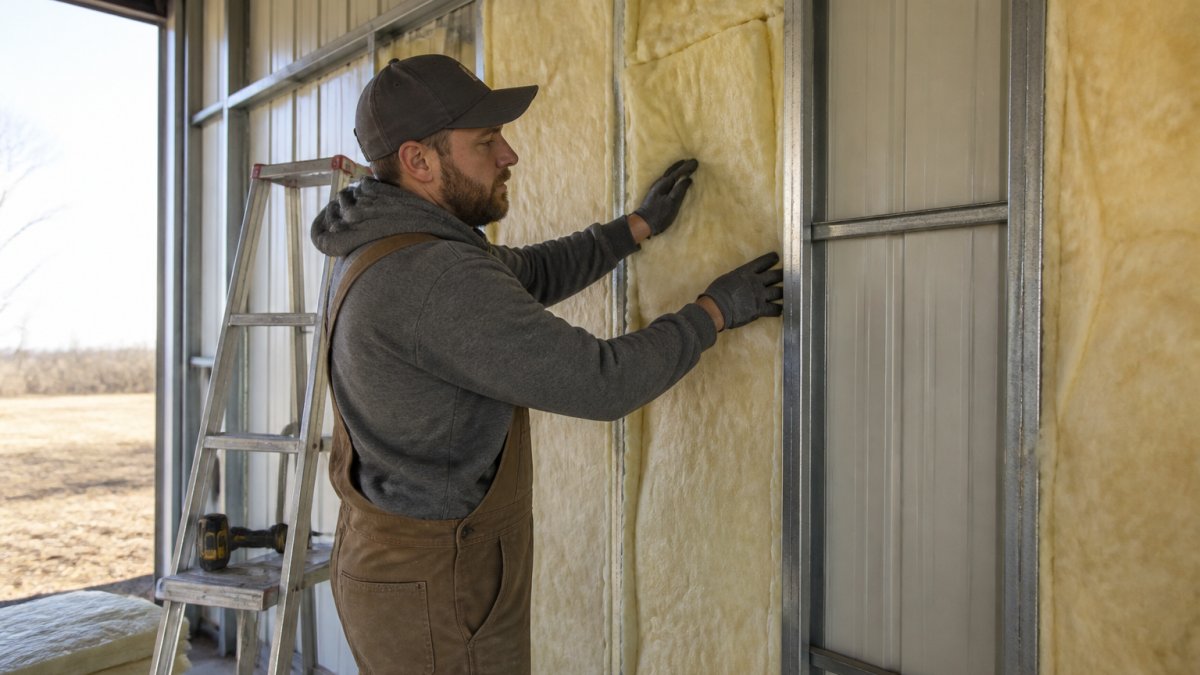
For a full walkthrough of the process on kit buildings, our guide on how to insulate metal building kits covers each step in detail. If snow load is part of your planning, the metal building snow load requirements explain what your roof and insulation plan need to account for.
Plan Your Workshop Build With Metal Carport Depot LLC
At Metal Carport Depot LLC, we build engineer-certified steel structures.
Our fully enclosed metal buildings are custom-sized at no extra charge, delivered and professionally installed at no additional cost across 37 states, and certified for local wind and snow loads. If you are still shaping the layout, our custom metal building design tips walk through the planning steps, and you can browse fully enclosed metal carports to see the enclosed options and request a quote.
Frequently Asked Questions
What is the best insulation for a metal building in a cold climate?
Closed-cell spray foam is often the strongest cold-climate choice because it insulates and acts as an air barrier in one step, which helps with metal building condensation control. Fiberglass blanket systems are the common budget option and work well when paired with a vapor retarder and careful sealing. Rigid foam board and reflective products can supplement either. The right pick depends on how often you heat the workshop and how much you can spend.
What R-value should a metal workshop have?
There is no single number that fits every workshop. Metal building insulation R-value targets depend on your climate zone, how the building is heated, and whether the insulation is continuous. Intermittently heated shops often benefit from higher R-values than the minimum because they must recover warmth quickly. Check local energy code requirements for your area and ask your supplier to confirm the whole-assembly R-value, not just the product label.
Is spray foam or fiberglass better for a metal building?
Spray foam insulation for metal buildings seals gaps and reduces air leakage, which makes it effective in cold, windy locations. Fiberglass blanket and batt insulation costs less and is easier to install, but it needs a vapor retarder and tight detailing to perform well. For a workshop heated only on weekends, a well-sealed fiberglass system can be enough. For a shop heated daily, spray foam usually delivers better comfort.
How do you prevent condensation in an insulated metal building?
Metal building condensation control starts with an air barrier and a vapor retarder on the warm side of the insulation. Seal penetrations, tape joints, and avoid leaving gaps where moist indoor air can reach cold steel. Ventilation also matters: a shop with welding, painting, or vehicle exhaust needs controlled exhaust. In cold climates, keeping the interior surface above the dew point is the goal, and continuous insulation helps.
Can you install insulation in an existing metal workshop?
Yes. Insulating an existing metal workshop usually means adding fiberglass blanket or rigid foam board between framing members, then sealing and covering the walls. Spray foam can also be applied to existing surfaces by a contractor. The main challenge is working around wiring, doors, and equipment. Plan the vapor retarder and air sealing details before you buy materials so the retrofit performs as intended.
Does metal building insulation need an air gap?
Reflective and radiant barrier products need an air gap to work as intended, because the gap is what slows radiant heat transfer. Fiberglass, spray foam, and rigid foam board do not rely on an air gap in the same way, though they must be installed tight to the surface. Read the manufacturer instructions for the specific product; installing a reflective barrier flat against steel defeats its purpose.
Insulating a cold-climate workshop is a planning problem before it is a product problem. Get the assembly right, seal the air paths, and choose materials that match your heating pattern, and the building stays usable through winter. Metal Carport Depot LLC can help you start with a structure designed for the insulation you need. Get started with Metal Carport Depot LLC and plan a workshop built for your climate, or call 1-800-324-5315 to talk through your build.