 how-to
How Long Do Steel Agricultural Buildings Last? 7 Key Factors
Last Updated: October 25, 2026
Quick Summary
Most steel agricultural buildings last between 40 and 60 years, and many reach 70 or more when well built and kept dry. Galvanized steel framing typically lasts 50 to 70 years or more, though roof panels and fasteners need replacing sooner.
- Roof panels with a factory paint system last 20 to 40 years before recoating or replacement.
- Fasteners and washers last 15 to 25 years and are the most common cause of leaks.
- Ammonia, manure acids, and fertilizer salts speed up corrosion on farm buildings.
- Inspect the building twice a year, in spring and fall, using a written checklist.
- Galvanized framing, good drainage, and ventilation are key design choices for long life.
Table of Contents
- How Long Steel Agricultural Buildings Last: The Realistic Range
- Component-by-Component: Where Age Shows Up First
- What Shortens a Steel Building's Service Life on a Farm
- How to Prevent Rust on a Metal Building
- Metal Building Maintenance That Actually Extends Service Life
- Your Steel Building Inspection Checklist
- Repair, Replace, or Keep Going: Reading the Signs
- Designing a Steel Building for the Long Haul
- Frequently Asked Questions
How Long Steel Agricultural Buildings Last: The Realistic Range
Most steel agricultural buildings last somewhere between 40 and 60 years, and many reach 70 or more when they are well built and kept dry.
At Metal Carport Depot LLC, we sell galvanized steel structures for farms, equipment storage, and machine sheds, so buyers always ask: will this still be standing when my grandkids run the place?
Below, we break down the real lifespan range, the parts that age first, and the maintenance steps that add years.
Why Lifespan Estimates Vary So Much
Lifespan numbers are not measured the same way by anyone. One source counts years until the frame fails, another until the roof needs replacing; one assumes a coastal site with salt air, another a dry inland field. That is why a 30-year figure and a 100-year figure can both be "right" and still tell you nothing about your own building.
Two other things move the estimate:
- Design life versus useful service life. Design life is what the engineer planned for. Useful service life is how long the building actually does its job. A shed can outlive its design life with good care, or fall short of it with neglect.
- Warranty terms. A warranty is a promise, not a measurement. What it covers and for how long matters more than the headline number. Our guide to metal building warranty coverage explains what is typically protected and what is not.
Treat any single number as a starting point, not a guarantee.
Component-by-Component: Where Age Shows Up First
A steel building does not age as one piece. The frame, roof, walls, and fasteners each wear at their own pace. Knowing which part fails first tells you where to spend your attention.
| Component | Typical Weak Point | What Speeds Up Wear |
|---|---|---|
| Roof panels | Cut edges and fastener holes | Ponding water, trapped debris |
| Wall panels | Bottom edge near the ground | Splash-back, soil contact |
| Fasteners | Washers and seals | UV exposure, over-tightening |
| Frame | Base plates and anchors | Standing water, poor drainage |
| Foundation | Cracks and settling | Weak site prep, poor grading |
The pattern is clear: water and the ground do the damage. If you are still weighing building types, our comparison of metal vs fabric farm storage buildings covers how each holds up over time.
Realistic Service-Life Ranges by Component
Treating the whole building as one lifespan hides the parts you will actually replace. Here are the ranges most builders and inspectors see under normal farm conditions:
- Galvanized steel framing: 50 to 70 years or more. The frame is usually the last thing to fail, provided the base plates stay dry and the anchors are sound.
- Roof panels with a factory paint system: 20 to 40 years before recoating or replacement. In high-ammonia livestock buildings, expect the lower end of that range.
- Wall panels: 25 to 45 years. Bottom edges near soil or bedding pack fail first, often 10 years before the rest of the panel.
- Fasteners and washers: 15 to 25 years. Neoprene washers degrade from UV and from repeated wet-dry cycles. This is the cheapest component to replace and the most common cause of leaks.
- Doors and openings: 15 to 30 years depending on hardware quality and use frequency. Roll-up doors on equipment sheds wear faster than walk-in doors.
The practical lesson: a building can remain structurally sound for 50 years while its roof panels, fasteners, and door seals are replaced two or three times. That is normal, and it is why a single lifespan number for the whole building is misleading.
Metal Building Roof Lifespan
A metal building roof typically lasts 20 to 40 years before recoating or replacement, depending on the paint system and climate.
Farm roofs take extra abuse: falling limbs, hail, and tree debris all shorten the coating's life, as does a low slope that lets water pool. Check the roof after every major storm and clear leaves and branches from the valleys.
What Shortens a Steel Building's Service Life on a Farm
Farm sites are harder on steel than residential lots. Ammonia from livestock areas, fertilizer dust, and manure all speed up corrosion, as does moisture that never dries. A building that stays damp at the base will rust from the bottom up, no matter how good the panels are.
Here are the biggest lifespan shorteners we see:
- Poor drainage. Water that pools at the base or under the slab keeps the steel wet.
- Soil and debris against the walls. Piles of dirt, feed, or equipment trap moisture against the panels.
- Damaged coatings. A scratch or a bad fastener seal is an open door for rust.
- No ventilation. Trapped humid air inside a closed building corrodes the frame from within.
- Heavy snow sitting on the roof. Snow load is a design issue, and a building not rated for it will sag.
Each of these is fixable. That is the good news.
The Agriculture-Specific Corrosion Problem
What separates a farm building from a general-purpose metal shed is the concentrated chemical load. Livestock urine breaks down into ammonia gas, which forms ammonium hydroxide when it contacts moisture on steel.
Manure and bedding acids add a second front.
Silage is its own category. Silage effluent is acidic and highly corrosive, seeping into concrete and steel wherever it contacts them (pubmed.ncbi.nlm.nih.gov).
How Farm Exposures Compare to General Metal Buildings
A general-purpose metal building on a residential lot faces rain, sun, and occasional lawn chemicals. A farm building faces those plus ammonia, organic acids, fertilizer salts, and constant humidity from livestock respiration and wash-down water.
The practical takeaway is to match your coating system and ventilation strategy to the specific farm use. A hay storage building has different corrosion pressure than a poultry house.
How to Prevent Rust on a Metal Building
Rust prevention comes down to three habits: keep water away, protect the coating, and catch damage early. Galvanized steel framing resists corrosion well, but the coating still needs care. Wash the walls and roof yearly to remove dirt and salt, touch up scratches and chips before they spread, and keep soil, mulch, and debris a few inches below the bottom edge of the panels so water drains away.
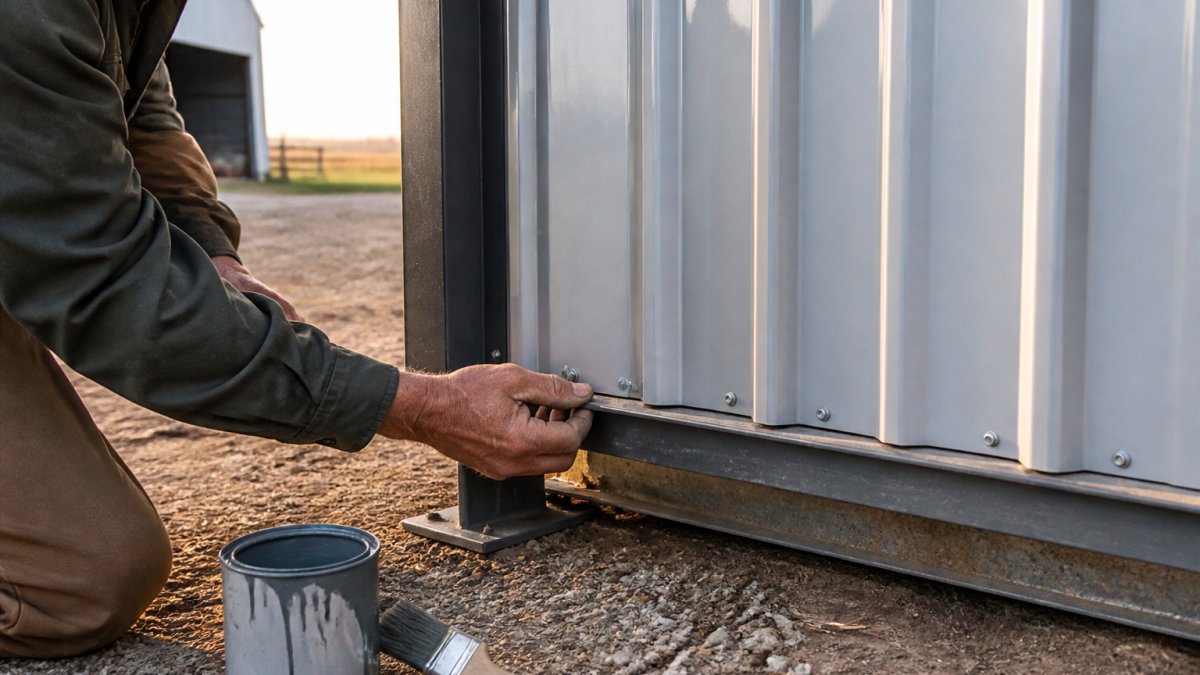
Fasteners deserve their own attention. For a full walkthrough, read our guide to preventing rust on metal carports, which applies to farm buildings just as well.
Metal Building Maintenance That Actually Extends Service Life
Routine maintenance is the cheapest way to add years to a steel building. The work is simple; what matters is doing it on a schedule instead of waiting for a problem.
A practical yearly routine looks like this:
- Inspect the roof and walls for scratches, dents, and loose fasteners.
- Clear gutters and drainage so water never pools.
- Wash the panels to remove dirt, bird droppings, and farm dust.
- Touch up coatings on any bare or scratched steel.
- Check the base for soil buildup and standing water.
- Look inside for condensation, leaks, or rust streaks on the frame.
Most of this is a weekend job once a year. Catching a small coating failure early costs far less than replacing panels later.
Your Steel Building Inspection Checklist
A steel building inspection checklist keeps you from missing the spots that fail quietly. Walk the building twice a year, in spring and fall, using this list:
- Roof panels: dents, loose screws, rust at edges
- Fasteners: cracked washers, missing screws, rust streaks
- Wall panels: bottom-edge rust, scratches, dents
- Base and foundation: cracks, settling, soil contact
- Drainage: gutters clear, no ponding near the slab
- Interior frame: condensation, rust streaks, leaks
Log what you find and the date. A simple record shows when a small problem starts getting worse, making the repair-or-replace call much easier.
Repair, Replace, or Keep Going: Reading the Signs
Small problems get fixed; big ones force a decision. Surface rust and a few loose fasteners are routine repairs. Rust that has eaten through a panel, a sagging roofline, or a frame pulled loose from its anchors are signs the building is near the end of its useful service life, structural issues, not cosmetic ones.
Here is how we would think about it:
- Repair when the damage is surface-level and the frame is sound.
- Replace panels when rust has perforated the steel in a few spots but the structure is solid.
- Replace the building when the frame, anchors, or foundation are failing.
If you are unsure which camp you are in, our frequently asked questions cover options, delivery, and installation so you can plan your next step with clear answers.
Designing a Steel Building for the Long Haul
The longest-lasting building is the one designed right from the start: a structure rated for your local wind and snow loads, a site that drains well, and materials that resist corrosion from day one.
When you design with us, you can size the building to your equipment, get engineered drawings for your permits, and see state-specific pricing before you commit. Our guide to designing agricultural equipment sheds walks through sizing, layout, and permits in more detail.
A few design choices that pay off over the decades:
- Galvanized steel framing for corrosion resistance
- A roof slope that sheds water instead of holding it
- Proper site grading so water moves away from the base
- Ventilation to control condensation inside
- Load ratings matched to your area for wind and snow
Build it right, keep it dry, and inspect it twice a year. That is how a steel agricultural building reaches the top of its lifespan range instead of the bottom.
The lifespan of your building starts with the decisions you make before it goes up.
Frequently Asked Questions
How long will steel agricultural buildings last?
Most estimates for steel agricultural buildings land between 30 and 60 years, with agricultural-building sources citing ranges from 30-50 years to 40-60 years. Some general steel-building sources describe service lives exceeding 100 years, but those figures usually assume ideal conditions and maintenance. What you actually get depends on coating quality, farm exposure, construction quality, and whether routine inspection happens. Treat any single number as a planning estimate, not a guarantee.
What factors affect the lifespan of a steel agricultural building?
The biggest factors are protective coating quality, moisture and humidity, exposure to corrosive farm materials like fertilizer and manure, construction quality and fastener choice, snow and wind load design, and maintenance habits. Agricultural buildings face harsher conditions than residential carports because of ammonia, dust, and equipment traffic. A galvanized frame with a sound paint system and regular inspections will outlast an uncoated structure on the same site by a wide margin.
Does rust shorten the life of a steel building?
Yes. Rust perforation is the leading cause of premature failure in steel panels and fasteners. Once corrosion eats through a panel or seizes a fastener, water intrusion follows, and repairs get more expensive. The practical defense is to catch rust early: touch up scratches, keep drainage clear, and inspect the wall base and roof edges where moisture collects. A steel building inspection checklist used once or twice a year catches most corrosion before it spreads.
How often should a steel agricultural building be inspected?
Walk the building twice a year, ideally before winter and after storm season, and do a quick visual check after any major wind or snow event. Look at fasteners, panel edges, the base of walls, roof penetrations, and drainage. Agricultural buildings with livestock or fertilizer storage warrant closer attention because ammonia and moisture accelerate corrosion. Keep notes so you can spot trends, like a fastener backing out or paint fading in one area.